

 By
By Entry level data analyst jobs often seem confusing at the beginning – especially when almost every job listing asks for experience.
When I first explored data analytics, one thing confused me – almost every job required experience. Even roles labeled “entry level” asked for 1–2 years of work history.
It felt frustrating and honestly confusing.
If you’re feeling the same, you’re not alone.
But after understanding the job market more deeply, I realized something important – many people getting hired are not experienced professionals. They’re beginners who simply followed the right approach.
What Entry Level Data Analyst Jobs for Freshers Really Look Like
Let’s remove the confusion first.
When people hear the term “data analyst,” they often imagine someone building complex dashboards, writing advanced code, or working with huge datasets all day.
In reality, most entry level jobs are quite basic.
Your day might include:
- Opening Excel files and fixing messy data
- Updating an existing report created by someone else
- Checking if numbers match between two sheets
- Creating simple charts for a manager
It might sound repetitive, but this is where real understanding develops. You begin to see how businesses actually use data in daily operations.
And that’s far more valuable than just watching tutorials.
Your work is more about supporting the team rather than leading big projects. You’re usually given structured tasks that help you understand how data is handled in a real business environment.
You might also spend time updating reports that are already created.
For example, a manager may have a weekly sales report, and your job is to refresh the data, make small adjustments, and ensure the numbers are accurate before it gets shared.
Over time, you begin to understand how these reports actually help teams make decisions.
Overall, entry level data analyst jobs are less about advanced skills and more about building a strong foundation.
Why Companies Still Hire Beginners

This is something many people misunderstand.
Companies don’t always need experts. In fact, hiring a highly experienced professional for basic data work is often unnecessary.
Here are the main reasons:
- Basic tasks need support: Work like cleaning data, updating Excel reports, and checking numbers is essential but doesn’t require advanced expertise
- Cost-effective hiring: Hiring beginners helps companies manage budgets while still getting the work done efficiently
- Easy to train and adapt: Freshers are more open to learning and can quickly adjust to company tools and workflows
- Long-term investment: Many companies hire beginners and train them internally for future higher roles
- High demand for data roles: With increasing reliance on data, companies need more people; not just experienced ones
In simple terms, companies don’t just look for experience – they look for people who are ready to learn and grow.
So instead of worrying about what you don’t have, focus on what you can offer – basic skills and a willingness to learn.
It may seem like companies only want experienced professionals, but in reality, many roles are designed specifically for beginners.
A lot of daily data work is routine and process-based, which is why companies continue to hire for entry-level analyst roles.
According to reports from the World Economic Forum, the demand for data-related roles continues to grow as companies increasingly rely on data-driven decision-making.
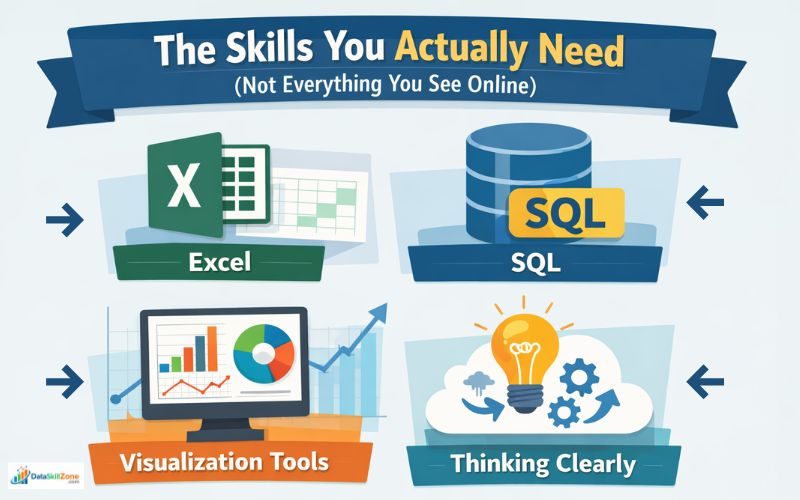
The Skills You Actually Need (Not Everything You See Online)
One of the biggest mistakes beginners make is trying to learn too many tools at once.
You are not required to learn Python, R, machine learning, and advanced statistics to get started.
Let’s keep it simple.
Many beginner learning paths on platforms like Coursera also focus on these core skills as the starting point.
1. Excel – Still the Most Practical Skill
Tools like Excel are still widely used in companies for everyday data tasks and reporting.
If you can:
- Clean data
- Use formulas like IF, SUM, VLOOKUP
- Create pivot tables
…you already have a strong foundation.
Many entry-level analyst roles still rely heavily on Excel for daily tasks.
When I started learning Excel, I also thought it was just for basic reporting. But over time, I discovered that it can actually lead to multiple high-paying roles. That’s why I created a detailed post explaining different career paths you can start with Excel.
2. Basic SQL — Just Enough to Work with Data
SQL sounds technical, but at the beginner level, it’s quite manageable.
You only need to learn:
- SELECT statements
- WHERE conditions
- Basic joins
That’s enough for most entry-level interviews.
3. Simple Data Visualization
You don’t need to build complex dashboards from day one.
Start with:
- Basic charts
- Clean layouts
- Simple dashboards
Tools like Power BI or Tableau are useful, but even Excel charts are enough initially.
4. The Most Important Skill: Thinking Clearly
This is often ignored.
Being a data analyst is not just about tools – it’s about understanding problems.
Even beginners who can think logically and explain data clearly often perform better than those who only know tools.
If you want to understand how practical skills can directly impact career growth, you can also explore the key skills that helped me grow faster in my career.
What Works Better Than “Experience”
Let’s talk about something important.
Most beginners think:
“I need experience to get a job.”
But the reality is:
👉 You need proof that you can do the work.
At the beginner level, companies know you won’t have years of experience. Instead, they look for proof of skills and effort.
This is where projects come in.
Instead of waiting for a job, create your own experience:
- Practical projects: Even 2–3 simple projects (like a sales report, Excel dashboard, or basic data analysis) show that you understand real work
- Hands-on skills: Being comfortable with Excel, basic SQL, and data cleaning matters more than just theoretical knowledge
- Problem-solving mindset: If you can explain how you approached a dataset and what insights you found, it leaves a strong impression
- Portfolio over certificates: Certificates show you completed a course, but a portfolio shows you can apply what you learned
- Consistency and effort: Regular practice and improvement often matter more than having a perfect background
- Clear communication: Explaining your findings in simple terms is a skill many beginners overlook, but companies value it highly.
These projects show employers that you’re ready for entry-level roles.
If you can demonstrate your skills through projects and explain your thinking clearly, you already stand out from many other applicants.
A Practical Roadmap You Can Actually Follow
If you’re serious about starting, don’t overcomplicate things.
The first step is to build a strong foundation – but keep it simple. You don’t need to learn everything at once.
For most junior data analyst jobs, only a few core skills are enough to get started.
Focus on learning the basics in a practical way rather than going too deep into theory.
Here’s what you should cover:
- Excel fundamentals: Learn formulas like SUM, IF, VLOOKUP, and practice using pivot tables and basic data cleaning
- Basic SQL: Understand how to select data, filter it, and perform simple joins
- Data visualization basics: Learn how to create clear charts and simple dashboards (even Excel charts are fine in the beginning)
Instead of just watching tutorials, try to practice alongside. For example, download a sample dataset and apply what you learn.
A simple 2–3 week approach can look like this:
- Week 1: Excel basics + practice
- Week 2: SQL fundamentals
- Week 3: Create simple charts or a small dashboard
The goal here is not mastery – it’s familiarity. Once you’re comfortable with these basics, you’ll already be prepared to move toward entry level data analyst jobs.
Don’t aim for perfection – aim for understanding.
Step 2: Build 2–3 Projects
This is where most people stop – don’t make that mistake.
Here’s what you should focus on:
- Choose simple, real-world topics:
Examples include sales analysis, customer data, or monthly performance reports - Work with real datasets:
You can download free datasets online or even use sample Excel data - Show a complete process:
Cleaning the data → analyzing it → creating a report or dashboard - Keep it easy to understand:
Your project should clearly show what problem you solved and what insights you found.
Projects help you:
- Demonstrate your practical skills
- Build confidence
- Talk clearly in interviews
- Stand out from other beginners
Even 2–3 well-structured projects are enough to demonstrate your practical skills and make you stand out from other candidates.
Learning skills is important, but what matters more is your ability to apply them. That’s exactly what projects demonstrate.
Step 3: Create a Resume That Shows Skills
Your resume doesn’t need to look impressive – it needs to be clear, relevant, and easy to understand.
For most beginner data analyst positions, recruiters spend only a few seconds scanning your resume, so what matters is how easily they can understand your skills.
Instead of worrying about “no experience,” focus on showing what you can do.
What to Include in Your Resume
- Skills section (keep it relevant):
Mention tools like Excel, SQL, and any visualization tool you’ve used - Projects (this is the most important part):
Briefly describe 2–3 projects you’ve built
- What was the dataset?
- What did you do?
- What insights did you find?
- What was the dataset?
- Education or certifications (optional):
Add only if relevant ; don’t overload this section
Avoid:
- Fake experience
- Generic statements like “hardworking and dedicated”
- Listing too many tools you don’t actually know
Being honest about your skills always works better than trying to impress with false information.
Your goal is simple – when someone reads your resume, they should quickly understand that you’re ready to start working.
Step 4: Apply Consistently (But Smartly)
Once your skills and resume are ready, the next step is applying.
But this is where many beginners go wrong. They either apply randomly to hundreds of jobs or give up too quickly after a few rejections.
Instead of applying randomly, search for:
- entry level data analyst jobs
- junior analyst roles
- remote data analyst positions
This increases your chances of getting noticed.
Apply daily, but focus on quality applications.
For entry level data analyst jobs, it often takes multiple applications before you get your first opportunity. Stay consistent, keep improving, and results will follow.
Step 5: Prepare for Basic Interviews
Once you start getting responses, the next step is clearing interviews.
Most beginner interviews are not very complex.
At the beginner level, interviewers focus on:
- Basic Excel knowledge: formulas, pivot tables, data cleaning
- Simple SQL queries: SELECT, WHERE, basic joins
- Understanding of your projects: what you did and why
- Problem-solving approach: how you think when given a small task
One of the most important things is that you should be ready to explain your projects because interviewers may ask questions based on your projects, such as::
- What was your project about?
- What problem were you trying to solve?
- What tools did you use?
- What insights did you find?
You should be able to clearly answer.
They are not expecting perfection; just clarity and confidence.
If you can explain your work clearly, you’re already ahead.
The good news is, if you’ve practiced your skills and worked on a few projects, you’re already halfway prepared.
This roadmap is designed specifically for beginners preparing for entry level data analyst jobs.
Remote Opportunities: A Big Advantage Today
A few years ago, starting a data career often meant finding a job in your city or relocating to a bigger location.
Now, things have changed.
Remote work has made entry level data analyst jobs more accessible than ever.
Instead of being limited to local companies, you can now:
- Apply to companies across different cities or countries
- Explore roles in startups as well as global organizations
- Find more openings that match your skill level
This increases your chances of getting hired.
This has opened doors for many beginners who otherwise wouldn’t have had these opportunities.
Many companies prefer remote hiring because it reduces costs and expands their talent pool.
As a result:
- More beginner-friendly roles are being created
- Companies are open to hiring freshers remotely
- Freelance and part-time opportunities are also increasing
Remote work has removed many barriers for beginners. Today, being in a specific city is no longer necessary to start your career.
With the rise of remote jobs, anyone with the right skills and consistency can find opportunities and grow in the data field.
Where to Find Real Opportunities
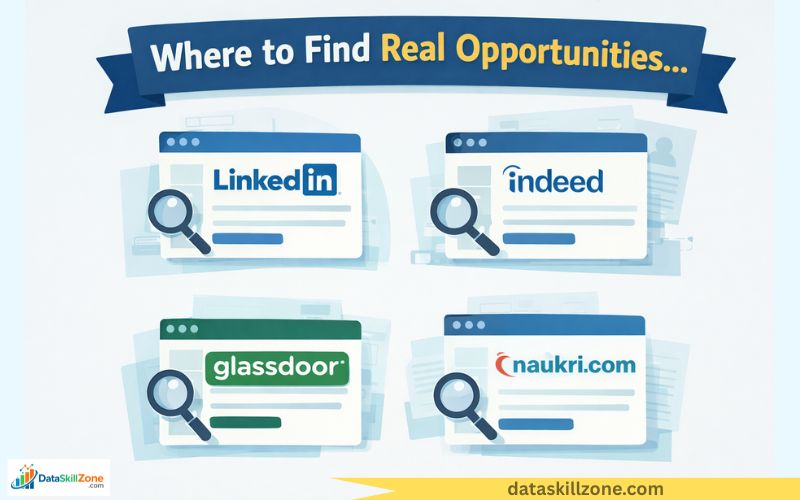
Instead of wasting time on random websites, focus on platforms that actually work:
- LinkedIn Jobs
- Indeed
- Glassdoor
- Remote job boards
- Freelance platforms like Upwork
The key is consistency. Many people apply for a few days and then stop.
Those who keep going eventually see results.
Common Mistakes That Hold Beginners Back
Let’s keep this honest.
Most people don’t fail because the field is difficult; they fail because of avoidable mistakes.
Here are a few:
- Trying to learn too many tools at once
- Not building any projects
- Waiting until they feel “perfect”
- Giving up after a few rejections
If you avoid these, your chances improve significantly.
| Expectation | Reality |
|---|---|
| Need 2–3 years experience | Many roles accept freshers |
| Need advanced coding | Excel + SQL is enough |
| Work is complex | Mostly repetitive tasks |
Is This Career Worth It in the Long Run?
This is a fair question.
The first job may not be perfect. The salary might be average. The work might feel repetitive.
But what it gives you is:
- Real experience
- Industry exposure
- A path to better roles
Many professionals who are now earning well started with basic entry level data analyst jobs.
As you gain experience, things start to change:
- Better salary growth: With 1–2 years of experience, your earning potential increases significantly
- Career progression: You can move into roles like senior analyst, business analyst, or even data scientist
- Skill expansion: You gradually learn advanced tools and techniques on the job
- More opportunities: Experience opens doors to better companies and remote roles
It’s not about where you start – it’s about how you grow.
As your experience grows, knowing how to communicate your value becomes just as important as your skills. Learning how to negotiate your salary effectively can make a big difference in your long-term career growth.
The biggest advantage of this career is that you don’t need a perfect background – you just need the right direction and consistent effort.
My Final Suggestions
Starting something new always feels confusing at first.
But data analytics is one of those fields where the barrier to entry is lower than it appears – especially today.
There’s no need to know everything or wait for the perfect moment to begin.
If you’re looking for a career that offers growth, flexibility, and long-term opportunities, data analytics is definitely worth considering.
You just need to start with:
- Basic skills
- A few projects
- Consistent effort
Opportunities are available, but the real challenge is preparing yourself to take advantage of them.
If you stay patient and keep improving, your first job is not as far as it seems.
FAQs
What are entry level data analyst jobs?
These are beginner-friendly roles where you work with data, create reports, and assist teams in making decisions.
Can I get a data analyst job without experience?
Yes, many beginners get hired by building projects and learning basic tools instead of relying on formal experience.
How long does it take to become job-ready?
With focused learning and practice, you can prepare for entry level data analyst jobs in about 4–8 weeks.
Do I need coding skills to start?
Not necessarily. Basic SQL is helpful, but strong Excel skills are often enough to begin.