

 By
By Introduction
A few years ago, if someone told you that data would become one of the most valuable resources in the world, it might have sounded strange.
Today, things are different. Businesses across the globe rely heavily on data to understand customers, improve products, and make better decisions.
Because of this shift, the demand for professionals who can analyze data has increased rapidly.
According to the U.S. Bureau of Labor Statistics, jobs related to data analysis and data science are expected to grow significantly in the coming years as organizations increasingly rely on data-driven decisions.
This is why many people today are searching online for how to become a data analyst and what the data analyst career path looks like.
But when beginners start exploring this field, they often feel overwhelmed. There are so many tools, courses, and tutorials that it becomes difficult to decide where to begin.
- Should you learn Excel first?
- Is SQL necessary?
- Do you need programming skills?
These questions are extremely common.
The good news is that becoming a data analyst does not require learning everything at once.
If you follow a clear data analyst career roadmap, you can build the right skills step by step and gradually grow into the role.
In this guide, I will walk you through a practical data analyst roadmap for beginners, explain the skills required for data analyst roles, and share examples that will help you understand how the journey usually unfolds.
First, Understand What a Data Analyst Actually Does
Before learning tools or technical skills, it is important to understand the real job of a data analyst.
Many people imagine data analysts sitting in front of complicated screens writing code all day.
In reality, the job is much more about solving business problems using data.
Let’s consider a simple example.
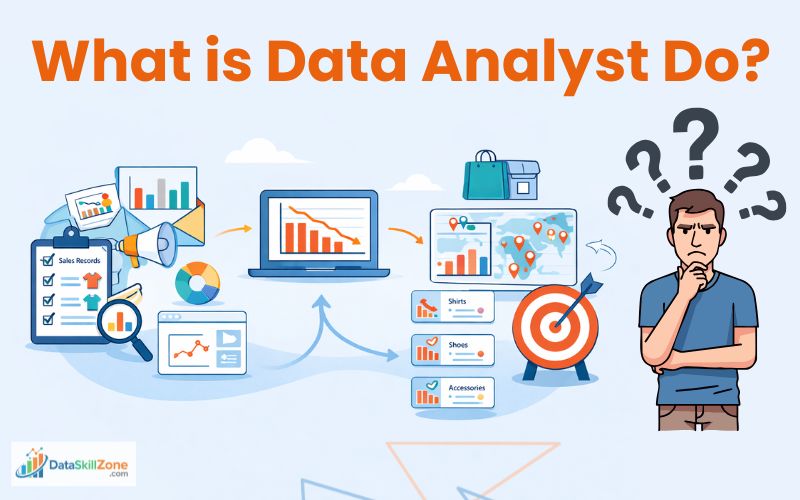
Imagine an online clothing store that sells thousands of products every month. The management team wants to know why sales dropped in the last quarter.
A data analyst might examine sales records, marketing campaign results, and customer behavior data. After analyzing this information, they may discover that sales dropped mainly in certain cities or product categories.
With this insight, the company can adjust its marketing strategy and improve performance.
This ability to turn raw numbers into useful insights is the core of the data analytics career path.
Following a clear data analyst career roadmap helps beginners avoid confusion.
Step 1: Start With the Basics of Data and Analytics
Every successful data analyst begins with a strong foundation.
Starting with advanced tools without first learning the basics often makes the learning process more confusing and difficult later on.
At this stage of the data analyst roadmap for beginners, focus on understanding how data works in the real world.
You should learn:
- what data analytics actually means
- how businesses collect and store data
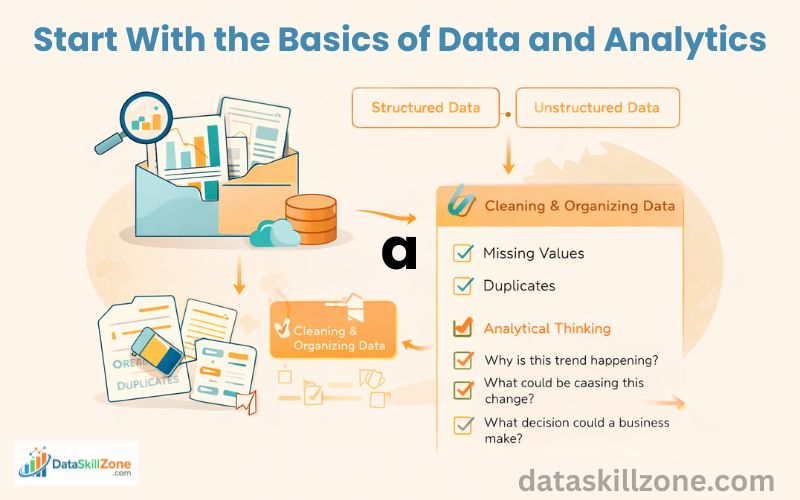
- the difference between structured and unstructured data
- why data cleaning is important
One thing beginners quickly realize is that real-world data is rarely perfect.
Datasets often contain:
- Missing values
- Duplicates
- Formatting issues
Cleaning and organizing this data is an important part of the job.
Another key skill to develop early is analytical thinking.
Instead of simply reading numbers, try to ask questions like:
- Why is this trend happening?
- What could be causing this change?
- What decision could a business make using this information?
Developing this mindset is one of the most important skills required for data analyst professionals.
Step 2: Learn Excel – The Foundation of Data Analysis
If there is one tool that appears in almost every data analyst career guide for beginners, it is Microsoft Excel.
Even today, Excel remains one of the most widely used tools for data analysis.
According to Microsoft’s official Excel documentation, the tool supports advanced data analysis features like Pivot Tables, Power Query, and data visualization.
Many organizations still use it for:
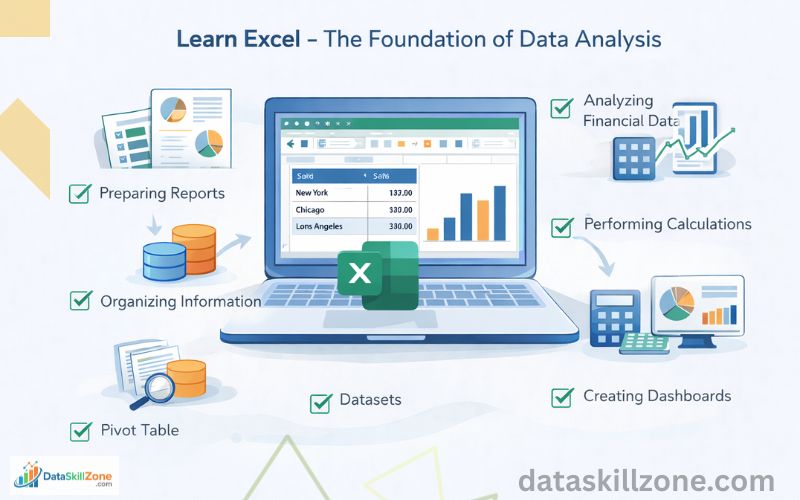
- Preparing Reports✅
- Analyzing Financial Data✅
- Creating Dashboards✅
In fact, many professionals working in MIS and reporting roles use Excel to build structured business reports.
If you want to understand the real process, you can explore this guide on 7 steps to design MIS reports in Excel.
For beginners, making use of Excel tool is the perfect starting point because it teaches important concepts such as working with :
- Datasets✔️
- Organizing Information✔️
- Performing calculations✔️
Some of the most valuable Excel skills include:
- sorting and filtering data
- creating Pivot Tables
- using formulas like VLOOKUP and XLOOKUP
- conditional formatting
- creating charts and reports
If you’re wondering what career opportunities Excel can open for beginners, you can explore these Excel jobs for freshers in 2026 to understand the types of roles companies offer to candidates with strong spreadsheet skills.
Let’s imagine you are analyzing sales data for a small business. The dataset contains thousands of transactions from different cities.
Instead of manually calculating totals, you can create a Pivot Table in Excel to instantly see which cities generate the highest revenue. This type of quick analysis is exactly what companies expect from data analysts.
Learning Excel well is a key step in the step by step data analyst roadmap.
Doing Pivot Tables in Excel 📈
One of the most useful Excel skills for anyone following a data analyst career roadmap is doing Pivot Tables in Excel.
Pivot Tables help you quickly summarize and analyze large datasets without writing complex formulas. They are widely used by businesses to generate reports, identify trends, and understand key performance metrics.
For example, if you have a dataset containing thousands of sales records, a Pivot Table can instantly show total sales by city, product category, or month.
This makes it much easier to understand patterns in the data.
Basic steps for doing Pivot Tables in Excel:
- Select the dataset you want to analyze
- Go to the Insert tab and click Pivot Table
- Choose where you want the Pivot Table to appear
- Drag fields into Rows, Columns, Values, or Filters
- Adjust the layout to explore different insights
By doing Pivot Tables in Excel, beginners can quickly turn raw data into meaningful summaries.
This skill is commonly used in real-world roles such as MIS analysts, reporting analysts, and data analysts, making it an essential step in the data analyst learning roadmap.
Step 3: Learn SQL to Work With Databases
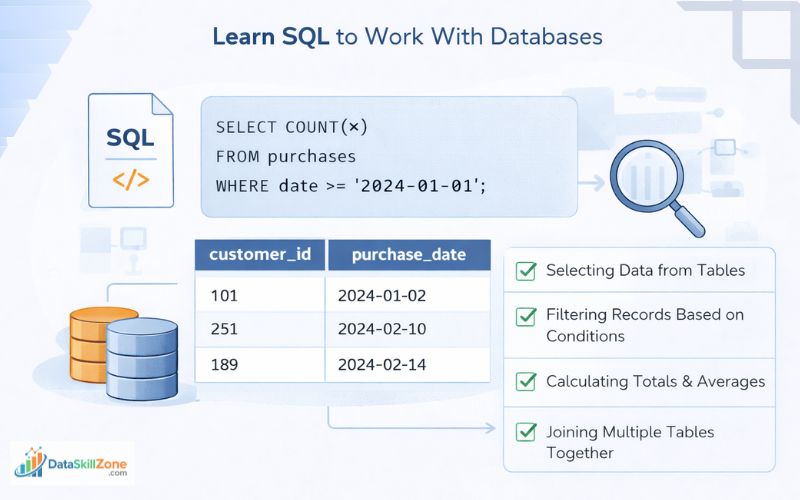
Once you are comfortable using Excel, the next step in the data analyst learning roadmap is SQL.
SQL stands for Structured Query Language and is used to retrieve data from databases.
While Excel works well for smaller datasets, companies usually store large amounts of data inside databases.
This is where SQL becomes essential.
Using SQL, you can ask specific questions about the data stored in a database.
For example, imagine a company wants to know how many customers made purchases in the last three months.
Instead of scanning thousands of records manually, a simple SQL query can retrieve this information instantly.
Some common SQL tasks include:
- selecting data from tables
- filtering records based on conditions
- calculating totals and averages
- joining multiple tables together
Because SQL is used in almost every data-related role, it is considered one of the most important skills required for data analyst jobs.
If you want to understand SQL queries in more depth, platforms like Kaggle provide free datasets and learning resources that beginners can practice with.
Step 4: Learn Data Visualization Tools
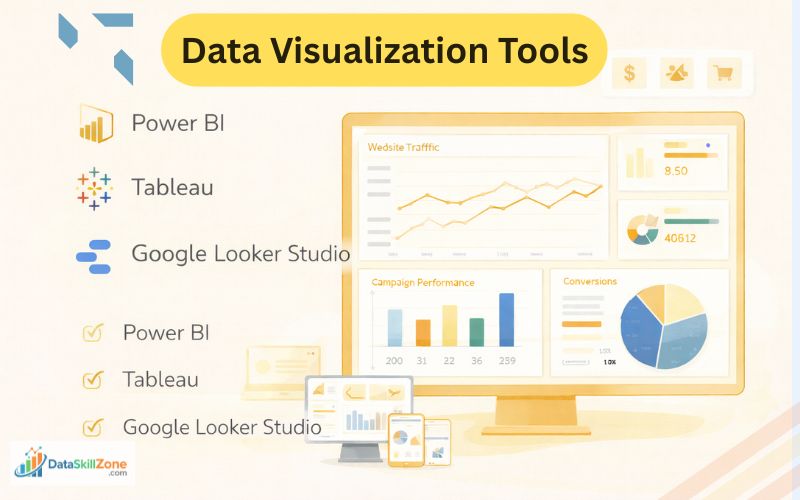
After analyzing data, the next challenge is presenting the results clearly.
Business leaders usually do not want to read long spreadsheets filled with numbers. Instead, they prefer visual dashboards that highlight key trends.
This is why visualization tools are an important part of the data analyst career roadmap.
Popular tools include:
These tools allow analysts to transform data into interactive dashboards.
For example, imagine you are working for a marketing team.
Instead of sending weekly Excel reports, you could create a dashboard showing campaign performance, website traffic, and customer conversions.
Managers can quickly see what is working and what needs improvement.
Learning how to design clear dashboards is an essential step in the data analyst career path.
Step 5: Learn Basic Programming (Optional but Powerful)
While programming is not always required for entry-level roles, learning a language like Python can significantly expand your capabilities.
Python allows analysts to automate repetitive tasks and analyze extremely large datasets.
For instance, if you need to analyze millions of website visits over several years, Python can process the data much faster than manual spreadsheet analysis.
Many professionals following the data analyst career roadmap eventually learn Python because it helps them perform advanced analysis.
However, beginners should remember that programming is an additional skill, not the starting point.
Beginners who want structured learning paths can also explore platforms like Coursera, which offer data analytics courses from universities and industry experts.
Step 6: Work on Real Data Projects
One of the most important stages in the data analyst roadmap for beginners is gaining practical experience.
Learning tools through tutorials is useful, but applying them to real datasets is where true understanding develops.
You can start by analyzing publicly available datasets.
For example, you might download an e-commerce dataset and explore questions like:
- Which products generate the most revenue?
- Which months have the highest sales?
- Which cities have the most customers?
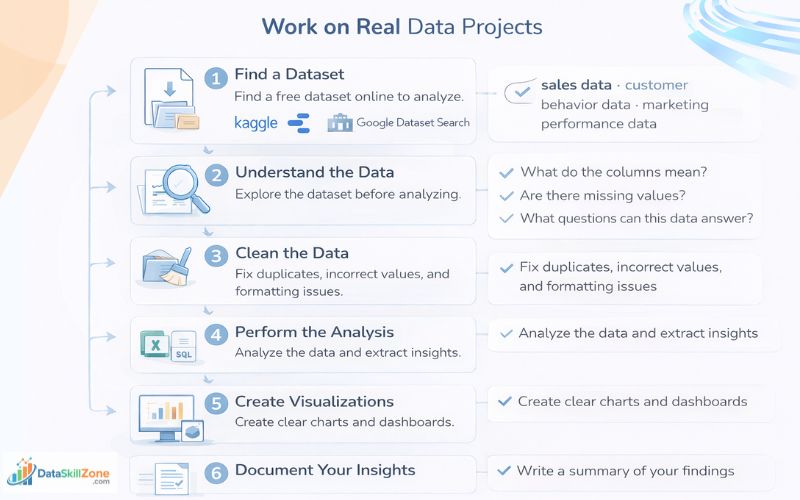
Below is a simple step-by-step approach you can follow to start building your own data projects.
1️⃣ Find a Dataset
Many websites provide free datasets that beginners can practice with.
Good sources include:
- Kaggle
- Google Dataset Search
- Government open data portals
- Sample datasets available online
Choose something simple at the beginning, such as sales data, customer behavior data, or marketing performance data.
2️⃣ Understand the Data
Before analyzing anything, spend some time exploring the dataset.
Ask yourself:
- What does each column represent?
- Are there missing values?
- Are there duplicate records?
- What questions can this data answer?
This step helps you understand how the dataset is structured.
3️⃣ Clean the Data
Use tools like Excel or SQL to clean the dataset.
For example:
- Remove duplicate rows
- Fix incorrect values
- Standardize date formats
- Handle missing data
Real-world data is rarely perfect. You may notice blank values, incorrect entries, or inconsistent formatting.
Data cleaning is actually one of the most important skills required for data analyst roles.
4️⃣ Perform the Analysis
Once the data is clean, you can begin analyzing it.
This may include:
- Creating Pivot Tables in Excel
- Writing SQL queries to extract insights
- Calculating totals, averages, or trends
- Comparing different categories in the dataset
5️⃣ Create Visualizations
After analyzing the data, the next step is presenting the results clearly.
You can create charts and dashboards using:
- Excel charts
- Power BI
- Tableau
Visualization helps people quickly understand insights without reading large spreadsheets.
6️⃣ Document Your Insights
Finally, write a short explanation of your findings.
Explain:
- What problem you analyzed
- What tools you used
- What insights you discovered
This documentation becomes very useful when building your data analyst portfolio.
Step 7: Prepare for Data Analyst Interviews
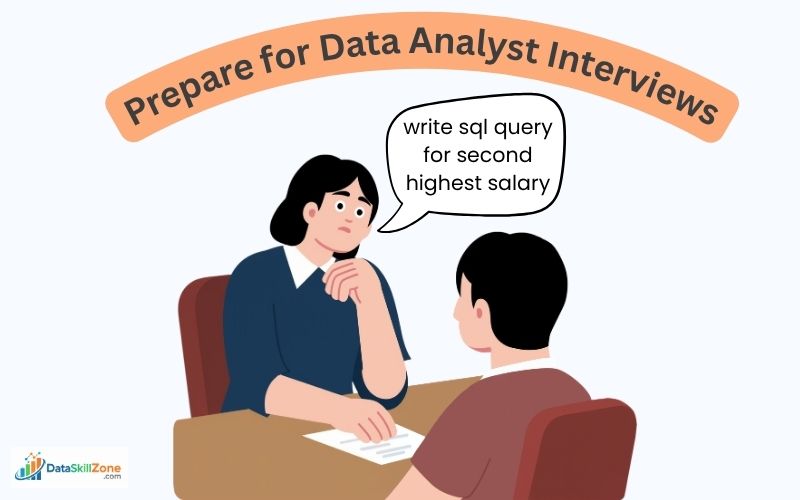
Once you have developed your skills and built a portfolio, the next step is preparing for interviews.
Most interviews for data roles include a combination of technical questions and business scenarios.
For example, interviewers may ask you to:
- write a SQL query
- explain how Pivot Tables work
- interpret a dataset to identify trends
They may also ask you to explain your projects.
Practicing these questions will help you feel more confident and prepared.
Step 8: Start Your First Data Role
After following the data analyst learning roadmap, you will be ready to apply for entry-level positions.
Common roles include:
- Junior Data Analyst
- Reporting Analyst
- MIS Analyst
- Business Intelligence Analyst
These roles provide valuable industry experience and help you understand how companies actually use data.
My Final Ideas For You
Starting a career in data analytics may seem challenging in the beginning, but the journey becomes much easier when you follow a structured data analyst career roadmap.
By focusing on the fundamentals, learning Excel and SQL, developing visualization skills, and working on real projects, you can gradually move forward in the data analyst career path.
If you want to see how this journey works in real life, you can also read about how I built my career in the MIS and data field, where I share practical lessons, challenges, and the steps that helped me grow in the data industry.
The most important thing is consistency. Learning a new skill every week and practicing regularly will take you much further than trying to learn everything at once.
If you stay curious, keep practicing, and continue improving your skills, you can build a rewarding career in one of the fastest-growing fields in the world.
💡 Pro Tip:
- Try to complete at least 3–5 small projects as part of your data analyst learning roadmap.
- These projects will not only improve your skills but also demonstrate your practical experience when applying for jobs.
- Working on real projects is often the moment when beginners truly start understanding how to become a data analyst, because they begin solving problems the same way professionals do in real companies.
- Projects like these demonstrate your ability to apply the skills required for data analyst roles in real scenarios.
FAQs
Yes, data analyst is considered a very good career choice, especially in today’s data-driven world. Companies across industries rely on data to understand customers, improve products, and make better business decisions. Because of this growing demand, professionals with strong data analysis skills are increasingly valuable in the job market.
To start a career in data analytics, beginners should focus on learning a few core skills. The most important skills required for data analyst roles include:
Excel for data analysis
SQL for database queries
Data visualization tools like Power BI or Tableau
Basic statistics and analytical thinking
Data cleaning and data preparation
Yes, having a data analyst portfolio can significantly increase your chances of getting shortlisted for interviews. A portfolio demonstrates that you can apply your skills to real datasets and generate insights.
For most beginners, learning the essential skills required for data analyst roles usually takes between 4 to 8 months with consistent practice.
Excel is a great starting point in the data analyst career roadmap. However, most companies also expect knowledge of SQL and data visualization tools like Power BI or Tableau.
Yes. Many entry-level roles mainly require Excel, SQL, and data visualization skills. Programming languages like Python are helpful but not always mandatory.